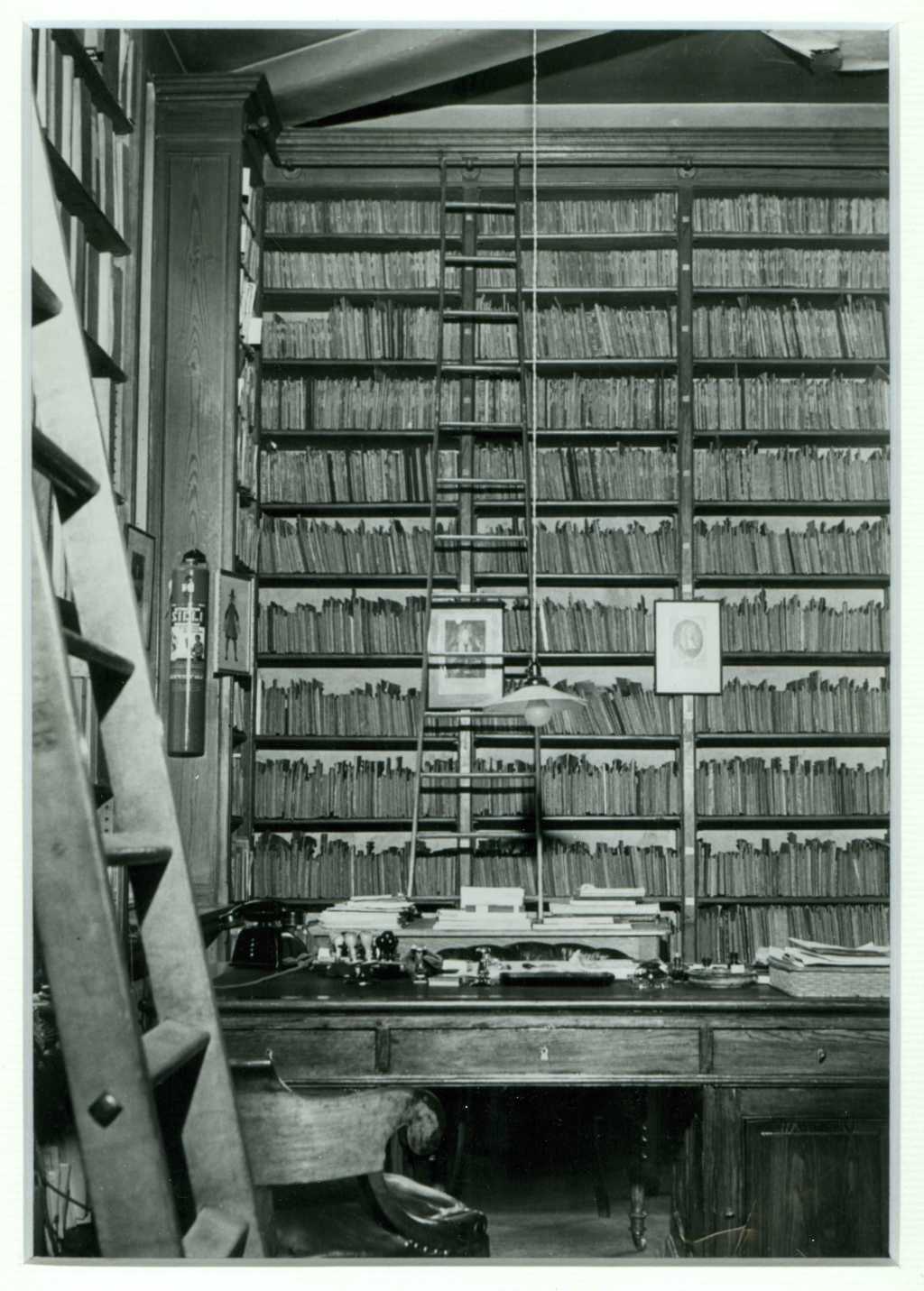

Diving into a new archive is an exciting and daunting task. This being my third institution where I am confronted with a large and completely unorganized archive of one sort or another, I know to expect anything. From bank statements used as bookmarks and slightly racy notes scribbled in documents, to letters and unknown musical manuscripts written by the most famous musicians. Nevertheless, the spirit of the librarian/archivist leaps at the opportunity to read every document and learn more about all sorts of subjects.
Music has always been a part of my life. In my family it was ever present. As a child I dreamed of being an archeologist, scribbling Indian Jones-esque contraptions as a way of keeping myself occupied. While I, often grudgingly, spent hours practicing the violin, it was only later that I considered music as a career option. In high school I begged my father (a music teacher) and my school band director to lend me whatever instrument they could spare so that I could learn the basics. All these influences nurtured the sort of musical archeology I have found myself occupied with for the last decades.
The Brussels Musical Instruments Museum (hereafter abbreviated as MIM) in particular holds fond memories for me. Arriving in Brussels in 1996 to audition for the viola da gamba class of Wieland Kuijken, I was confronted upon landing with the fact that British Air had somehow lost my instrument. I learned then and there to never put my instrument in the baggage hold, no matter how well packaged. While I waited a week for my instrument to arrive, I explored the MIM which was as the time in a building attached to the Brussels Conservatoire.
I had seen and played a wide selection of renaissance and baroque instruments in high school and college; however, the collection of the MIM seemed to present every conceivable type of instrument from all over the world. As a student at the conservatoire, I heard stories of buildings throughout Brussels where more instruments of the MIM were stored. At its current location the MIM presents around 1,200 instruments in a large museum. It is difficult for the visitor to imagine without seeing it, that there are several large repositories in this building, as well as an entire other building which houses the rest of its more than 14,000 items.
Behind each of these instruments is a story. Not only the instrument’s history, but the story of how they came to the museum, from who, how they were used, and who played them. These are the stories which we find in the archives of the MIM. The MIM has and continues to welcome an incredible number of famous musicians and personalities. From Franz Liszt to Toots Thielemans and the King of the Zulus, they have all admired the MIM’s collection and even played on their instruments in some cases! These stories too are told in the archives.
This blog will focus on the little stories, about an instrument, a person, or an event, found in the MIM archives. You don’t need to be an expert organologist or even a musician to appreciate it but I will provide you with the appropriate links if you wish to fall down any particular rabbit-hole. Hopefully I have whet your appetite and you’ll come back for more!
- Richard Sutcliffe, July 2024
 MUSIM
MUSIM 
Leave a comment